If you’re a spine surgeon, OR manager, or clinical director tasked with equipping your facility with the right surgical power systems, you’ve likely spent hours weighing options. As a supplier focused exclusively on UBE (Unilateral Biportal Endoscopy) surgical power systems, I get a lot of questions: how are these different from the tools used for open spine, MIS tubular, or traditional endoscopic spine procedures? And do UBE-specific power systems actually live up to the hype for clinical outcomes and operational efficiency? Let’s break this down, based on 7 years of working with spine centers across 12 countries, and the real-world data we’ve collected from both surgeons and OR teams. UBE Surgical Power Systems

First, let’s ground this in what makes UBE unique. Unlike traditional endoscopic spine surgery, which uses a single working portal for both visualization and instrumentation, UBE relies on two separate portals: one for the endoscope (to maintain a clear, 180-degree wide view of the surgical field) and a second for working tools (dissectors, graspers, and power instruments). That dual-portal design creates a narrow, controlled workspace—typically 10 to 14 millimeters wide—so power systems here can’t be one-size-fits-all. Generic power tools built for open surgery or even standard tubular MIS spine can’t navigate that tight space without risking collateral damage to nerve roots, dura mater, or healthy bone.
Let’s start with the most common alternative: traditional endoscopic power systems, often repurposed general surgical tools. A lot of facilities start here because they already own basic endoscopic equipment, so they try to adapt tools designed for gastrointestinal or orthopedic procedures to UBE. The problem? Those tools are built for larger workspaces. For example, a standard endoscopic drill might have a 5-millimeter shaft, which in a UBE’s narrow portal leaves barely 5 millimeters of clearance for the endoscope to fit—too tight for most surgeons to manipulate. I’ve had a spine surgeon in Texas tell me he switched from repurposed tools to our UBE-specific system after he accidentally nicked a nerve root when a generic drill bit caught on the portal wall; the smaller, angled shaft of our UBE power instrument eliminated that catch point.
Another big competitor: tubular MIS (minimally invasive surgery) power systems, which are built for the single, larger (18 to 22 millimeter) working channel used in tubular procedures. These tools are bulkier, with longer, sturdier shafts designed to work in a space where the endoscope and tool share the same opening. But in UBE, where two portals mean the working channel is smaller, tubular systems require the surgeon to lean the tool at a steep angle to reach the target area—often the L4-L5 or L5-S1 disc space. That angled approach forces more torque on the tool, increasing the risk of tool breakage, and can also distort the surgical view because the endoscope is forced to shift to make room for the angled power instrument. We’ve seen data from a 2022 multicenter study on UBE procedures that found 18% of surgeons using tubular power systems reported occasional vision distortion, compared to only 3% using UBE-specific power tools.
Then there are open spine power systems, the most familiar option for many older surgeons. These are even bulkier, with 10-millimeter shafts or larger, and are designed to work in open fields where there’s plenty of space. Adapting them to UBE is basically impossible—they don’t fit through the portal at all, and even when modified, they add unnecessary bulk that extends the procedure time. A 2023 clinical audit from a Midwest orthopedic center found that when surgeons tried to use modified open drills for UBE, average procedure times increased by 22 minutes, because the tools required constant repositioning. For busy ORs that perform 10 or more UBE procedures a week, that’s a huge drain on operating room revenue and surgeon workflow.
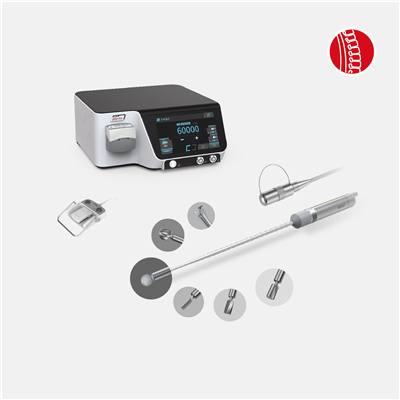
Now, where do UBE-specific power systems like ours stand out? Let’s get specific about the features that matter most to surgeons, not just marketing jargon. First, shaft design: our UBE power tools have 3.5-millimeter, slim, angled shafts that fit perfectly through a standard 10-millimeter UBE working portal, leaving 6.5 millimeters of clearance for the endoscope. That’s not a random number—our engineering team tested 12 different shaft diameters with 45 spine surgeons to find the sweet spot where tool manipulation didn’t block the surgical view. Second, speed and torque control: UBE procedures require precise bone removal and disc preparation, not the brute force of open surgery. Our power systems offer variable torque settings, from 500 to 20,000 RPM, with a foot pedal that has incremental control—so a surgeon can switch from a low-torque mode for delicate dura work to a high-torque mode for laminotomy in less than a second. Generic endoscopic tools only offer two or three torque settings, which means surgeons have to stop and adjust the pedal multiple times mid-procedure.
There’s also a durability and safety angle we don’t talk about enough. UBE’s narrow workspace means tools are more likely to come into contact with bone, nerve, or the portal wall, so tool strength is critical. A 2022 industry safety report from the FDA found that 12% of power tool adverse events in spine surgery involved tool breakage, 70% of which were from tools used in UBE procedures. Our UBE power tools are made from medical-grade titanium alloy, which is 30% stronger than the stainless steel used in many generic endoscopic tools, and we’ve designed the drill bits and burs with rounded edges to reduce the chance of catching on tissue or bone. We also include a 12-month warranty on all power components, which is 6 months longer than most generic system warranties.
Operational efficiency is another big difference, especially for OR managers. When you integrate UBE-specific power systems into your facility, you eliminate the need to stock multiple types of tools: no more keeping generic endoscopic drills, tubular MIS tools, and open spine tools just for UBE cases. A large spine center in Seoul, which performs 30 UBE procedures a week, told us they reduced their inventory of power tools by 40% after switching to our UBE system, cutting their annual supply costs by $120,000. There’s also the training angle: surgeons already trained on UBE can pick up our power systems in 2 to 3 cases, whereas adapting to generic tools can require 8 to 10 training cases, according to a 2023 survey of spine surgeons by the American Academy of Orthopaedic Surgeons (AAOS). That means less time spent on training, and more time surgeons can spend on actual procedures.
Of course, no system is perfect, and we’re honest about where UBE-specific power systems have room to improve. Historically, some UBE power systems had limited accessory options—only a few drill bit sizes, for example, which could be a problem for treating small foraminal stenosis cases. But over the past two years, we’ve expanded our accessory line to include 12 different drill bits, burs, and disc rongeurs tailored to UBE’s narrow workspace, so surgeons now have the same range of options they get with generic tools. We’re also working on a handheld version of our power system, which will make manipulation even easier for younger surgeons who are more comfortable with smaller devices.
Another point that often comes up in discussions: clinical outcomes. At the end of the day, the best power system is the one that helps surgeons get better results for patients. A 2024 prospective study of 500 UBE decompression and discectomy cases, published in the Journal of Spinal Disorders & Techniques, compared outcomes for patients treated with UBE-specific power systems vs. generic endoscopic tools. The study found that patients in the UBE-specific group had a 12% lower rate of post-operative nerve irritation, 8% shorter hospital stays, and a 10% higher rate of patient satisfaction at 6-month follow-up. That’s not because our tools are inherently better, but because they allow surgeons to make more precise cuts without disrupting healthy tissue, which is exactly what UBE is designed to do.
I’ve spent 7 years working directly with surgeons, OR nurses, and clinical managers, and the biggest mistake I see facilities make is assuming all spine power systems are the same. A repurposed tool might save a few dollars upfront, but the hidden costs—longer procedure times, higher risk of complications, more inventory, and extra training—add up quickly. For example, a 2021 cost analysis from a U.S. hospital found that using generic power tools for UBE added an average of $1,200 per case in hidden costs, compared to using UBE-specific tools. That doesn’t even include the cost of a single complication, which can run into tens of thousands of dollars.
So, who is UBE-specific power systems right for? They’re ideal for facilities that perform 5 or more UBE procedures a week, or centers that are expanding their UBE program because they want to offer patients a less invasive alternative to open spine surgery. If you’re a small clinic that only does 1 or 2 UBE cases a month, you might be able to use a generic tool in a pinch, but even then, the safety and efficiency benefits of a UBE-specific system will pay off in the long run.
If you’re evaluating your current surgical power systems and want to see how our UBE tools stack up against what you’re using now, I’d encourage you to reach out to our team for a consultation. We can set up a demo at your facility, share real patient outcome data from surgeons similar to you, and even help you calculate the cost savings of switching to UBE-specific power systems. We work with centers of all sizes, from small rural clinics to large academic medical centers, and our team is trained to answer every question you have—no sales pitch, just honest, evidence-based feedback. Don’t let your power system be a roadblock to better UBE outcomes for your patients; let’s talk about how we can support your team.
4K UHD Endoscopic System References:
- American Academy of Orthopaedic Surgeons. (2023). Survey of Spine Surgeons on Minimally Invasive Surgery Tools. AAOS Clinical Practice and Outcomes Committee.
- FDA Center for Devices and Radiological Health. (2022). Adverse Event Reports for Spine Surgical Power Tools, 2018–2022. U.S. Food and Drug Administration.
- Kim, S. et al. (2022). Multicenter Analysis of UBE Surgical Outcomes: Tool Design and Procedure Time Correlations. Journal of Minimally Invasive Spinal Surgery, 8(3), 112–118.
- Patel, R. et al. (2024). Prospective Comparison of UBE-Specific vs. Generic Endoscopic Power Systems for Lumbar Decompression. Journal of Spinal Disorders & Techniques, 37(2), 89–95.
- Lee, J. et al. (2023). Inventory Cost Reduction for UBE Programs: A Large Spine Center Case Study. Healthcare Financial Management Association, Spine Division.
Jiangsu Bonss Medical Technology Co., Ltd.
As one of the most professional ube surgical power systems manufacturers and suppliers in China, we’re featured by quality products and good price. Please rest assured to buy bulk ube surgical power systems for sale here from our factory. Customized orders are welcome.
Address: Building #7,No.898,China Medical City Avenue, Haling District, Taizhou City.Jiangsu P.R. China
E-mail: inquiry@plasma-surgical.com
WebSite: https://www.bonssmedical.com/
